The Innovation & Incubation Centre at SVS serves as a dynamic launchpad for the next generation of entrepreneurs. Our platform is dedicated to nurturing the entrepreneurial spirit by providing a robust ecosystem where young minds can transform creative research and innovative ideas into viable, market-ready business ventures.
Ideation & Nurturing
Cultivating a culture of innovation by encouraging students to explore and develop high-potential business concepts.
Technology Ventures
Promoting knowledge-driven and tech-based startups among our students, faculty, and alumni.
Showcasing Talent
Providing platforms for students to display their projects and represent the institution in national-level Project Expos.
Ecosystem Support
Bridging the gap between initial innovation and successful commercialization through professional guidance and institutional support.
Solar Power Plant
A solar power plant is an arrangement of various solar components including a solar panel to absorb and convert sunlight into electricity, a solar inverter to convert the electricity from DC to AC while also monitoring the system, solar batteries and other solar accessories to set up a working system.
The main concern of a solar power plant is to provide complete energy independence while also lowering your electricity costs. It includes both small and large capacity solar systems ranging from 1kW to megawatts.
A solar power plant is also known as a solar energy system, solar system, solar power system and solar plant. There are various technologies used in solar power plants, but solar photovoltaic technology is the best option for collecting maximum sunlight and converting it to electricity.
Solar power plants are mainly available in three different types:
On Grid Solar
Connected to the utility grid, allowing excess power to be fed back.
Off Grid Solar
Battery-based independent system, ideal for remote locations.
Hybrid Solar
Combines grid connectivity with battery backup for maximum reliability.
Off Grid Solar System with Battery Backup
The off-grid solar system is a battery based, independent solar system that does not need a utility grid to illuminate your places. It is a complete solar setup with solar panels, solar battery, and solar inverter, and is ideal to lighten a home even in a far off location.
This solar system is more prominent as it comes with a power backup.
Components and Working
The system consists of three essential components: Solar Panel, Solar Inverter, and Solar Battery.
1
The solar panels capture the sun's energy and convert it to DC power.
2
A solar charge controller regulates the voltage of DC generated by the solar panel. The solar inverter cum controller monitors and measures how much energy is being produced, harvesting the maximum possible energy.
3
The regulated DC gets stored in the battery bank. In the event of surplus solar power and less load, energy is stored in the battery while simultaneously catering to the load.
4
This stored power can be used any time using a solar inverter to convert DC into AC to power home appliances.
Innovation: Solar E-Bike
As we all know, fuel prices, especially petrol, are rising steadily day by day. Again, the pollution due to vehicles in metro cities & urban areas is increasing continuously. To overcome these problems, an effort is being made to search for some other alternative sources of energy for the vehicles.
Again, it is also not affordable to purchase vehicles (mopeds, scooters or motorcycles) for all the classes of society. Keeping this in mind, a search for some way to cater these economically poor people as well as to provide a solution for the environmental pollution was in progress.
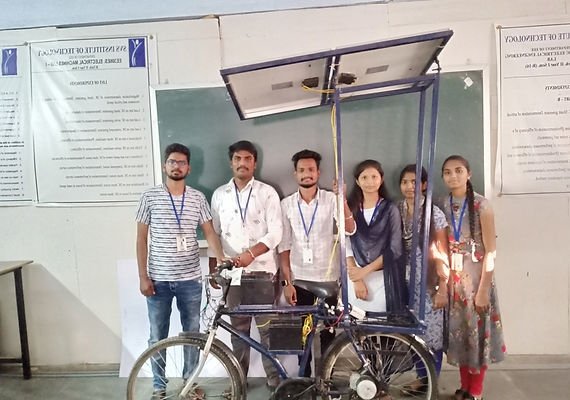
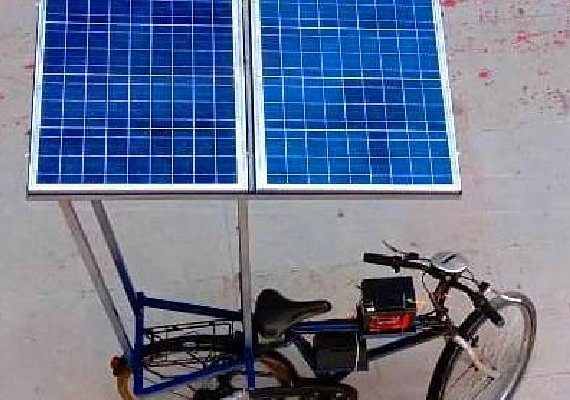
The solar assisted bicycle developed is driven by a DC motor fitted in front or rear axle housing & operated by solar energy. The solar panels mounted on the carriage will charge the battery & which in turn drive the hub motor. When the bicycle is idle, the solar panel will charge the battery.
This arrangement will replace the petrol engine, the gear box & the fuel tank in case of a two wheeler or a chain sprocket, chain & gear shifting arrangement of a conventional bicycle being used by most common man.
As a part of dissertation work, the solar assisted bicycle is fitted with a DC hub motor on the front axle of a bicycle with power rating of 250W and with a travelling speed of around 25–30 kmph. It is provided with a pair of lead acid batteries of 35 Ah each, a photovoltaic solar panel with capacity of 20 watt, a voltage regulator of 24V 10 Amp, accelerator and motor controller of 24V 25Amp.
There is also a provision for charging the battery with 220–240V AC wall outlet supply, in case of poor solar supply due to cloudy weather.
As what had been mentioned earlier, there are several types of bicycle that can be categorized: paddle bicycle, motorized bicycle, and electric bicycle. The weakness of the bicycle makes people not like to use bicycles. First, paddle bicycles need a lot of energy to paddle the bicycle. The user will surely be tired after using the bicycle. This will not be suitable for students to use to go to the class because they will be tired when they are in the class and will lose their concentration while hearing the lecture.
Next, motorized bicycle that uses fuel as its prime mover. The bicycle uses fuel that is costly. As a student, their allowance is limited and only can be used for their study material and for their food to survive at the campus.
Besides that, motorized bicycles will make pollution that can be very bad for our environment especially in this period that global warming happens to the earth.
Lastly, electric bicycles that are generated by batteries can only be sufficient for about an hour. The user needs to find power supply to recharge.
Project Methodology
Solar Cells / Panels
The lead acid battery is charged with solar energy with the help of a solar cell. Solar cells convert the energy of sunlight directly into electricity through the use of the photovoltaic effect.
The photovoltaic effect involves the creation of a voltage into electro-magnetic radiation. The photoelectric and photovoltaic effects are related to sunlight, but are different in that electrons are ejected from a material's surface upon exposure to radiation of sufficient energy in photoelectric, and generated electrons are transferred to different bands of valence to conduction within the material, resulting in the build-up of voltage between two electrodes in photovoltaic.
SPV Charge Controller
It is essential to regulate the voltage output from the solar panel before it is supplied to the battery. A voltage regulator is a power converter with an output DC voltage greater than the input DC voltage.
The output of the solar panel is not always stable due to fluctuations in intensity of sunlight, angular changes with respect to the direction of sunlight, as well as other environmental factors.
Our voltage regulator/boost converter requires output of the solar panel, which can range from 0V to 27.2V, and output for charging of the battery. The SPV Instruments Module has the characteristics of taking in an input range of 9.6V to 13.2V and outputting 24V at a maximum of 2–3 amps, with an area of 2.5 square inches making it very feasible to be placed anywhere on the bicycle.
PIC Controller
Here we use PIC16F72 controller to control the electric bicycle system. Different functions include under voltage protection, over current protection, control power supply, and to drive and control the Brushless DC motor.
The PIC16F72 controller has 28 pins, 22 I/O pins that are user configurable on a pin-to-pin basis. There are 35 number of instructions. The operating frequency is 20 MHz with three I/O ports (PORTA, PORTB and PORTC) and three Timers (Timer0, Timer1 and Timer2).
The current detection signal is used because if any heavy current situation occurs, the electric bicycle running at heavy load increases current in the motor which can damage the winding and components. Under voltage protection is required to avoid low voltage supply affecting normal operation, with the controller providing capacity checking.
Battery
Lead acid batteries are one of the most popular types of battery in electronics. Although slightly lower in energy density than lithium metal, lead acid is safe, provided certain precautions are met when charging and discharging.
Current supplied from the battery indicates the flow of energy from the battery and is measured in amperes (or Amps). The higher the current flow the faster the battery will discharge. A battery is rated in ampere-hours (abbreviated Ah) and this is called the battery capacity.
This project demands a battery with longer running hours, lighter weight with respect to its high output voltage and higher energy density. Among all the existing rechargeable battery systems, the lead acid cell technology is the most efficient and practical choice. The battery chosen was a high capacity lead acid battery pack designed specifically for vehicles with plastic casing to house the internal components.
SVS Group of Institutions takes pride in its commitment to holistic student development, having conducted a diverse array of workshops and seminars dedicated to enhancing essential skills.